SUNDAY, MAY 29, 1994,
'Liberators' Worth Seeing
Truths About Blacks, Jews in Another War
COURTLAND MILLOY
 sa
R. Gordon has a war time fight on his hand. He wants us to see the documentary
"Liberators: Fighting on Two Fronts in World War II, "which is about the
role of black soldiers in the liberation of Nazi concentration camps.
sa
R. Gordon has a war time fight on his hand. He wants us to see the documentary
"Liberators: Fighting on Two Fronts in World War II, "which is about the
role of black soldiers in the liberation of Nazi concentration camps.
His opponents are formidable. Criticism that the documentary is an
inaccurate portrayal led public television station WNET in New York to
withdraw the film from U.S. broadcast distribution last year.
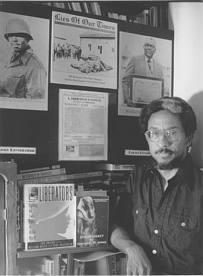 Gordon, an aerospace engineer at the Goddard Space Flight Center and a
black history scholar, says not so fast. For the last year, he has been
combing the files at the National Archives and coming up with some pretty
impressive evidence - photographs and declassified Army messages-- that
document the presence of black troops at Ohrdruf, Dachau and Buchenwald
concentration camps.
Gordon, an aerospace engineer at the Goddard Space Flight Center and a
black history scholar, says not so fast. For the last year, he has been
combing the files at the National Archives and coming up with some pretty
impressive evidence - photographs and declassified Army messages-- that
document the presence of black troops at Ohrdruf, Dachau and Buchenwald
concentration camps.
"My goal is to redress the shameful memorial revisionism that has
consigned the African American soldiers and the Jewish survivors they helped
liberate to a historical purgatory," Gordon said.
"This failure Is America's legacy to each succeeding generation.
Once again, I am struck by that void of men and women of color in the televised
50-year memorial tributes to  contributions of American soldiers in World War II."
If it sounds like Gordon is taking this rather personally, he is.
His late first cousin William Alexander Scott III, was honored in 1981
by the United States Memorial Council "for valiant service during the 1944-45
liberation by Allied forces of Nazi concentration camps.
Scott was featured in "Liberators." Discrediting the film was a slur
against Scott's valor. He had served as a reconnaissance sergeant, photographer,
camoufleur and historian in the all-black 183rd Engineer Combat Battalion,
in the 8th Corps of General George S. Patton's 3rd Army.
"During one of my childhood visits to Scott's home, I came upon this
trunk of photographs that he'd taken during the war, and I was horrified,
Gordon recalled. "They were pictures of Holocaust victims and survivors
that he and other members of 183rd had encountered upon entering Buchenwald."
Some of those pictures are now on display at the U.S. Holocaust Memorial
Museum. And one of the pictures appears in the most prominently displayed
book for Memorial visitors, "The World Must Know," with a caption that
reads, "Sergeant William A. Scott along with other American liberators
view the stacked bodies at Buchenwald, Germany."
Despite an abundance of photographic proof of the presence of black
troops at the concentration camps, a headline in the New Republic in 1992
referred to the film as "The Exaggerators." The New York Guardian denounced
the film as an "unholy hoax," and Accuracy in Media proclaimed the documentary
a "PBS scam."
"What's in dispute," wrote Morton Silverstein in a report on the
controversy prepared for WNET, "are some of the film's major claims, or
conveyed impressions, that members of the (all-black 761st Tank Battalion)
liberated Buchenwald on April 11, 1945, and Dachau on April 29, 1945, and
that members of the 183rd Engineer Combat Battalion helped liberate Buchenwald."
Silverstein is an Emmy award- winning documentary filmmaker.
The dispute arose because there were no Army records confirming that
the 761st and the 183rd were on the scene at the time. The reason for that,
Gordon says, is because the two black units were split apart and attached
to other units. Moreover, Gordon discovered, the records for the 183rd
for the time in question are missing from the Archives' Washington National
Records Center.
Keep in mind, Gordon says, that cavalier treatment of black soldiers,
which included ignoring their battlefield accomplishments, was part of
the American way in those days.
"When the written record does not suffice, or is absent altogether,
we are left to make our judgments on the credibility of eyewitnesses to
the events in question," Gordon argues.
On that score, Gordon has more than enough ammunition.
He cites, among many eyewitness accounts, an interview published
in the New York Times in 1989 with Nobel Prize-winning author Elie Wiesel,
who was liberated in Buchenwald.
"The most moving moment of my life was the day the Americans arrived,
a few hours after the SS had fled," Wiesel said. "It was the morning of
April 11. I will always remember with love a big black soldier. He was
crying like a child-all the pain in the world and all the rage. Everyone
who was there that day will forever feel a sentiment of gratitude to the
American soldiers who liberated us."
According to Silverstein's report, the " 'Liberators' is indisputably
an important compelling documentary."
There is indeed no dispute that the film shows that African American
soldiers courageously fought not only on the European front but also on
the home front. After responding to the call of duty by offering their
lives for their country, they returned home to find their lives threatened
and diminished by racism at home.
It is now time for all people to honor the humanity and courage demonstrated
by the African American soldier in stepping forward to aid the liberation
of a people who would be their allies for the next 50 years in a common
struggle to obtain human dignity and rights," Gordon said.
Whatever its faults, it's time to see this film.
 "LIBERATORS
UNDER FIRE"
"LIBERATORS
UNDER FIRE"