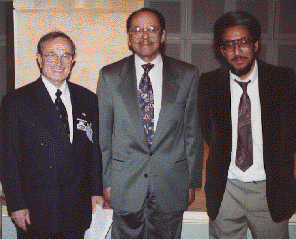
Alex Gross-Jewish survivor of Buchenwald,
Leon Bass-a Buchenwald liberator,
Asa Gordon-Founder and Executive Director(DIG)
United States Holocaust Memorial Museum,
April 11th, 1995
(Photo by Anthony Gordon)
Alex Gross-Jewish survivor of Buchenwald,
Leon Bass-a Buchenwald liberator,
Asa Gordon-Founder and Executive Director(DIG)
United States Holocaust Memorial Museum,
April 11th, 1995
(Photo by Anthony Gordon)
There are lessons from the past that are timeless, or they should be. Buchenwald, a death camp of the Holocaust during World War II, offers such a lesson. On April 11th, 1995, the 50th anniversary of the liberation of Buchenwald, I was privileged to appear in a special program at the United States Holocaust Memorial Museum's Rubenstein Theater on behalf of the museum's Washinton D.C. area school project entitled, "Bringing the Lessons Home: Holocaust Education for the Community." I was joined in the program by Alex Gross, a Jewish survivor of Buchenwald, and Leon Bass, one of the camp's African American liberators. The theme of our address was the universal human lessons we could draw from the singulaly inhuman events of Buchenwald. The following are excerpts from my address on that occasion.
It was an honor. The old Indian who had been my companion for much of the day had asked me to join his council fire. I was being invited to join in the next day's planning for THE LONGEST WALK protest. THE LONGEST WALK was a spiritual walk, a historical walk of native people, a walk commemorating all the forced walks Indian people were forced to make in the twilight of their own holocaust. THE LONGEST WALK grew out of the concern of Indian people for the anti-Indian legislation currently before Congress. That mid-summer day in 1978, Native peoples had come to camp at Greenbelt Park in Greenbelt, Maryland as a base for protest from all over the North American continent. I experienced both pride and embarrassment when the old man introduced me as a great warrior and chief of a "think tank" tribe that served the cause of my own people. As I took my seat before the glowing council fire, one of the young Indian activists asked me, "Why are you here?". It was a statement, not a quesion. The old Indian was about to reproach the youth for his impetuousness, but I stopped him. It was the first time I would share with anyone a lesson of humanity that I had learned in my youth, the answer as to why I was at the council then, and why I am here now. The lesson of Buchenwald.
Often during my life-long struggle as an activist for human justice I have reflected on that distant summer day in the "Jimcrow" south of my youth when I first gazed upon A haunting photograph by the late William A Scott III, former Advertising Manager of the Atlanta Daily World. Scott's photograph is a timeless frozen image of African-American soldiers transfixed by emancipated bodies stacked like cordwood before them, enthralled by this numbing, souless slice of horror of the Holocaust. Only a few years had passed since the end of World War II. The United States had fought without compromise in the allied victory over fascism in Europe, but it still surrendered to its own brand of racism at home.
I remember how excited I was on the train to Atlanta. We were going to visit my cousin William A. Scott, III, a soldier who fought in the war against the Germans. During the whole trip I bragged to my buddy "Bumpy" about my cousin. We would hear "real" war stories from a "real" veteran, not the make-believe characters of the Hollywood dime war movies.
But whenever we would try to get Scott to tell us about his wartime adventures, he would change the subject. It became obvious to us that he did not want to talk about the war. We could never understand how that could be, since, at that time, war had not lost its glorious hold on our youthful imaginations.
Then there was that day. My friend and I were returning from a park playground, when we came upon a black man who was arguing with the driver of a bus from which he had been forced off by the white passengers. He shouted that his money was as good as any one's, and that he should be able to sit wherever he pleased. Later that day we were sitting on the front stoop of Scott's home talking about what had happened. In the vernacular of those days in the segregated south "we talked about how "the man(the white man) treated colored folks". Why did white folks hate colored folks so much? Scott, emerging from the house, overheard us and said, "Come with me, let me show you how white folks can treat white folks. I'll tell you some war stories." Wow, were we excited. Well, we did eventually get to hear some "real" war stories that day, but the story I most remembered came from the photos he pulled from the trunk in his basement. The war photos he showed us were not what we expected. They were of his personal encounter with the Holocaust, and the lesson of those pictures was not lost on us.
We look back to the past in order to illuminate the present, so that we may gain insight into the future. There are words from the past that express the lesson I learned that day, the lesson Scott taught us with "those pictures". The words are from the namesake of the educational research thinktank I would later found in tribute to Frederick Douglass. I am always amazed that I can look back to the namesake of my organization and find a timeless and fitting observation for any occasion in the words of the venerable Frederick Douglass. The lesson we learned that day, the lesson of Buchenwald, the lesson of the universality of human suffering was expressed in a letter Frederick Douglass wrote to his abolitionist friend William Lloyd Garrison on February 26, 1846. In response to questions by his critics as to why, given the profound plight of his own people, he should expend any of his considerable talents in the cause of others, Douglass wrote:
"Though I am more closely connected and identified with one class of outraged, oppressed and enslaved people, I cannot allow myself to be insensible to the wrongs and sufferings of any part of the great family of man I am not only an American slave, but a man, and as such, am bound to use my powers for the welfare of the whole human brotherhood."That is why I was there that day with my native American brothers.
For those who would question my presence at this gathering today, this lesson may help explain how I came to be here. It is a lesson that illuminates why we have gathered here and, hopefully, the universal humanity of all who would visit here. It is the universal lesson to which I believe the U.S. Holocaust Memorial Museum is dedicated.
The writer is executive director of the Douglass Institute of Government
Atlanta Daily World April 11-12, 1996
 "LIBERATORS
UNDER FIRE"
"LIBERATORS
UNDER FIRE"